


🌊Tropicxs📡 on Instagram
688K views, 86K likes, 1,116 comments: "🇪🇨💤 La selección de ...
www.instagram.com
Every time we use a service online, there is a combination of servers finding ways to deliver the content directly to you as fast as possible. When these servers have errors, there needs to be a way to track and monitor these errors. Enter Data Dog.
Datadog, Inc. operates an observability and security platform for cloud applications in the United States and internationally. The company's products comprise infrastructure and application performance monitoring, log management, observability pipelines, synthetics, real user monitoring, product analytics, continuous profiler, database monitoring, data observability, LLM observability, error tracking, network monitoring, incident response, workflow automation and App builder, event management, bits AI SRE, cloud cost management, cloud security, code security, cloud SIEM, threat management, sensitive data scanner, and CI visibility. Datadog, Inc. was incorporated in 2010 and is headquartered in New York, New York.
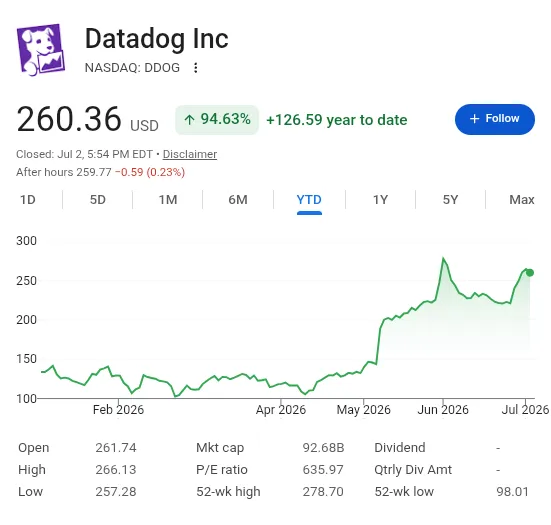
To date, with the absolute insanity with AI integrations Data Dog appears to be well positions to provide critical insights for users based on these enhancements.
With a P/E ratio of 635, the stock might be overvalued to date and the investors may have missed the train on this stock.

All around Houston, homeowners are preparing for hurricane season. Generac Generators turn on backup power for a home that has lost power due to XYZ. Their commercials are on TV constantly and the generators themselves were on back order last year after a series of Hurricanes. This market became saturated with competitors but there's no denying the leader is Generac.
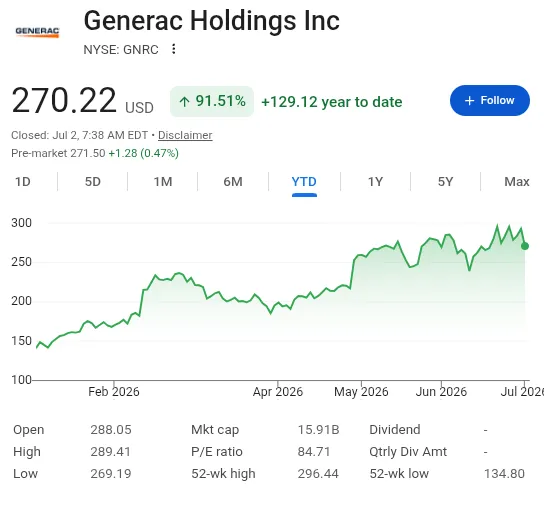
Generac has in up 91% this year. Talk about a sleeper!

The global landscape of finance is undergoing a seismic shift as the battle for the control of money enters a new, high-stakes phase centered on the revaluation of gold and the dismantling of paper-based trading systems. In a series of coordinated moves throughout mid-2026, China's largest financial institutions, led by the Industrial Commercial Bank of China (ICBC), announced they would shut down paper gold trading for retail investors effective July 24th. This policy shift, also adopted by the Postal Savings Bank of China, Pingan Bank, and China Guangfa Bank, signals a major pivot away from speculative financial instruments toward physical asset dominance.
The Official Narrative vs. The Price Discovery Theory
The official explanation provided by Chinese authorities is one of investor protection. Following a period of extreme volatility where gold prices surged to an all-time high of over $55,000 per ounce in January before crashing to approximately $4,000 per ounce, banks have sought to mitigate retail losses by hiking margin requirements to a record 140%. This requirement essentially demands more collateral from a trader than the underlying investment is worth, making leveraged trading nearly impossible.
However, the unofficial theory suggests a more strategic motive: real price discovery. By removing margin trading and leveraged deferred contracts—essentially "paper gold"—China aims to strip away decades of market speculation and gambling that have suppressed the actual value of the metal. The goal is to determine what gold is truly worth when it is no longer tied to paper claims that often exceed the actual physical supply.
The Illusion of "Paper Gold"
To explain the danger of the current system, the source utilizes an analogy of a rare "Ancient Mew" Pokemon card. If a person owns one physical card but sells ten paper certificates claiming ownership of that same card to ten different people, a false supply is created. On paper, the market believes ten cards exist, which drives the price down to a fraction of its true value.
This "fractional" system is currently how major Western markets, such as those in London and New York (Comex), operate. Most gold traded daily consists of contracts and claims that are rarely settled with physical delivery. The source notes that if all paper claim holders simultaneously demanded their physical metal, the system would collapse because the number of claims vastly outweighs the physical gold sitting in vaults. By shutting down these paper markets, China is attempting to break this cycle of price suppression.
Central Bank Behavior and Shadow Accumulation
Evidence of this transition is found in the behavior of the world's most sophisticated financial actors: central banks. In the first quarter of 2026, central banks purchased a net 244 tons of physical gold, marking the strongest first quarter in recorded history. This trend is not new; banks have bought over 200 tons in 10 of the last 11 quarters.
Crucially, much of this activity is "shadow accumulation," where purchases are not officially reported to the public. The World Gold Council estimates that the real volume of gold being hoarded by nations—particularly China—could be ten times higher than official reports suggest. Simultaneously, these nations are dumping US Treasuries. For over 50 years, the global standard was to park excess dollars in US debt to earn interest. Now, China has sold hundreds of billions in US debt to rotate those funds into gold, an asset that pays zero interest but offers protection from a "forever war model" funded by infinite money printing.
China's New Financial Infrastructure
China is not merely exiting the old system; it is building a parallel financial architecture designed to shift the center of the gold market from the West to the East. This system relies on a partnership between the Shanghai Gold Exchange and Hong Kong.
To facilitate this, Hong Kong is expanding its physical vault capacity tenfold, from 200 tons to over 2,000 tons. The strategic objective is to use gold as an anchor for the Yuan. By pricing major commodity deals in Yuan and allowing them to be settled against physical gold in Shanghai, China provides a reason for the world to trust and hold its currency, challenging the US dollar’s hegemony without engaging in direct military conflict.
The United States’ Counter-Strategy
The United States is not oblivious to these developments and may be preparing its own gold-centered response. A significant, yet often overlooked, fact is that the US Treasury still values its 8,000 tons of gold at a 1973 statutory price of only $42 per ounce. With gold currently trading near $4,000 per ounce, there is a trillion-dollar valuation gap on the government’s books.
With a simple "stroke of a pen," the US could revalue its gold to market prices, instantly adding over a trillion dollars in value to the Treasury's balance sheet without issuing new debt. Treasury officials have already discussed "monetizing the asset side" of the US balance sheet within the next year. Furthermore, proposals exist for a 50-year Treasury bond redeemable in either dollars or physical gold, which would effectively re-establish a link between the dollar and gold for the first time since 1971.
A Potential Monetary Declaration of Independence
There is significant speculation that the US might time this revaluation for July 4, 2026, the nation's 250th anniversary. Such a move would serve as a "monetary declaration of independence," countering China’s efforts to anchor the Yuan by doing the same for the dollar. Whether through a direct price increase in gold or a massive devaluation of the dollar, the end result remains the same: a total restructuring of what the world considers "money".
Ultimately, the source suggests that the current era of "paper promises" is ending. As gold flows from West to East and becomes the top US export, it is clear that central banks are hoarding "real money" while dumping paper claims. This shift represents the birth of a multipolar financial world where physical assets, rather than printed currencies, dictate global power. For investors, this marks a transition from a "healthy" market to one defined by systemic distrust and the urgent need for tangible security.
We're a week out from July 4th and I'm trying to figure out what to do with the day. There's a lot of events out there on that day so maybe we end up heading out into down town. According to Google...
You're welcome in this website.
So I had a relative pass away recently and needed some quick cash in mxn pesos. I went to a local exchange and received the price of the exchange. The exchange rate they gave me was 0.06280 USD or 1 USD = 15.92 MXN.
I last went to Wells Fargo around the time of this original post and got the same exchange rate MXNUSD instead of USDMXN. I finally signed up for an account and found that Wells Fargo will pay a better price than local exchanges and they will send you the money two ways: 1) ship to local branch for exchanges less than 3000 or 2) if you want it mailed directly to your home with signature it's 3,000 minimum exchange.
At this time, Wells Fargo offers 0.06171 MXNUSD or 1 USD = 16.20 MXN.
It's a no brainer. Wells Fargo all the way.
Silver recently experienced a significant decline, touching an intraday low of $64.26, which represents a 14% drop for the month. This price action is the result of two separate but converging stories: a hawkish shift in Federal Reserve monetary policy and a major technological transition within the solar industry.
The first story involves a "mechanical" shift in monetary expectations. Nine Federal Reserve officials now project at least one rate hike before December 2026, a sharp move from zero officials in the previous dot plot. With the probability of a September hike sitting at 70%, bond yields have spiked, with the 2-year Treasury reaching 4.19%. Because silver does not pay interest, these higher yields increase the opportunity cost of holding the metal, driving capital into fixed-income assets and strengthening the US dollar.
Simultaneously, a structural shift occurred in industrial demand. Longi Green Energy, the world's largest solar manufacturer, announced it has begun replacing silver with copper in commercial production. This move was driven by silver’s rising cost, which jumped from 3% to 29% of a solar module's total expense in just three years. This substitution is expected to cause a 20% reduction in silver usage across the solar industry over the next 18 months, potentially removing 37 million ounces of annual demand.
Despite these bearish headlines, the source argues the structural supply deficit remains the dominant long-term force. While solar demand is contracting, other sectors—including electric vehicles (up 8%), AI infrastructure (up 12%), and defense (up 6%)—are increasing their silver consumption. Overall industrial demand is only expected to contract by 3% this year, remaining well above 550 million ounces.
Crucially, global supply cannot easily respond to these shifts. Approximately 70% of silver is mined as a byproduct of other metals, meaning production is tied to copper and zinc demand rather than silver prices. This has resulted in a projected 46 million ounce deficit for 2026, marking the sixth consecutive year of structural shortfall.
Moving forward, the $60 price level is the critical technical support; holding above this keeps the long-term bull market intact. With the gold-silver ratio at 62 suggesting undervaluation and physical investment demand projected to rise 20%, the current correction may represent a value opportunity as finite above-ground inventories continue to be depleted.