


Conspiracy Proofs on Instagram
78K views, 4,268 likes: "They told you the war was over. That peace ha...
www.instagram.com


This video, "Gold & Silver Just Got HUGE News — Here's What It Means for You," warns of a quiet but highly significant shift currently unfolding in the global financial system. It argues that three major forces—climbing national debt, growing strain in the bond market, and upcoming Federal Reserve policy signals (specifically surrounding the Jackson Hole Symposium)—are on a collision course that will soon reshape how people protect their savings.
The video focuses on several critical developments and historical patterns:
1. The Treasury’s "Boring" Intervention
The video highlights a technical and largely unnoticed move by the US Treasury Department: announcing a buyback of its own older bonds. The video explains that this is an artificial attempt to suppress rising long-term borrowing interest rates. Historically, governments do not step into smoothly running markets; they intervene when they are worried, signaling real financial strain behind closed doors.
2. Dollar Weakness and Gold’s Rise
Immediately following the Treasury's announcement, the US dollar weakened while gold prices climbed. The video notes this is a classic pattern: when investors realize a government is artificially manipulating its bond market rather than letting free forces price it, they run to hard assets like gold that cannot be printed or diluted by policy decisions.
3. Parallels to the 1970s
The video draws strong historical parallels to the 1970s, an era defined by high government spending, a weakening currency, rising oil prices, and a massive disconnect between official economic reassurances and the actual cost of gas and groceries. During that decade, gold and silver experienced massive structural moves as people realized the dollar was rapidly losing its purchasing power.
4. The Unique Double-Role of Silver
While gold acts primarily as a monetary hedge, the video emphasizes that silver plays a unique double role. It is both a monetary metal and an indispensable industrial material for modern technologies like solar panels, electronics, and medical equipment. This dual identity means silver can benefit from industrial demand and currency flight at the same exact time.
5. Institutional Positioning
Finally, the video points out that large institutional investors and highly respected hedge fund managers are already speaking out about currency risks and quietly shifting portfolios into gold. Because these large funds manage immense capital, they must reposition slowly over weeks or months, meaning they are often fully prepared long before the public recognizes the shift.
Ultimately, the video advises viewers to pay attention to these quiet, technical signals—rising yields, weakening currency, and government interventions—rather than waiting for a dramatic, loud announcement when it is already too late.
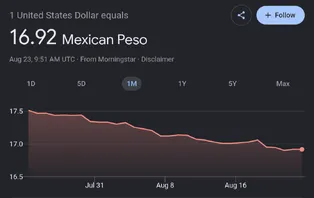
The Peso is increasing increasing in value against the dollar.
Today 1 pesos now costs .059 cents compared to it being .057 just a month ago.
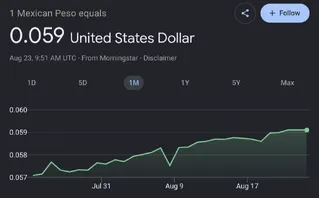
The inverse relationship means purchasing with the dollar is giving less pesos to the buyer.
In May 2026, the United States government made a historic and quiet departure from its traditional role in the economy. Instead of acting merely as a customer of innovation by writing grants, the Department of Commerce announced letters of intent to invest $2 billion across nine quantum computing companies, taking direct minority equity stakes in them. This means the federal government now has direct financial upside if these companies succeed, and direct exposure if they fail.
The video breaks down this unprecedented development into several key areas:
Spreading the Bets Across Competing Technologies
Because nobody—including government officials—knows which technical architecture will ultimately succeed, the funding was deliberately spread across nine companies utilizing vastly different approaches to quantum computing:
The architectures funded span superconducting gate-based systems, photonics, neutral atoms, and quantum annealing.
Wall Street's Explosive Reaction
The announcement triggered an immediate rally in the stock market. While IBM's stock jumped 12%, smaller quantum companies that did not even receive funding also surged—such as Arkit (up 25%) and IonQ (up 12%). Wall Street interpreted the government's direct equity ownership as a massive "soft validation" that fundamentally lowered the risk profile of the entire quantum computing sector.
The Geopolitical Engine: National Security & Encryption
This shift is not about the government trying to make a venture-capital profit. It is an urgent national security counter-move against China, which has poured massive state funding into its own quantum research.
A fully realized quantum computer will have the power to break the encryption safeguarding global banking transactions, government communications, and military secrets. Because adversaries are already practicing a "harvest now, decrypt later" strategy—collecting and storing encrypted data today to crack it decades from now once quantum technology matures—Washington has reclassified quantum computing as a strategic national asset.
A New Era of American Industrial Policy
This quantum initiative is part of a broader, quiet shift over the past year where the administration has taken direct stakes or governance rights in strategically sensitive industries. This includes semiconductors, nuclear energy, rare earth minerals, and a "golden share" arrangement in US Steel.
The video notes that this strategy has sparked a major debate:
Ultimately, the video concludes that the US government has officially tied its own balance sheet to the success of the private quantum computing industry, a structural shift that Wall Street is already actively trying to price.
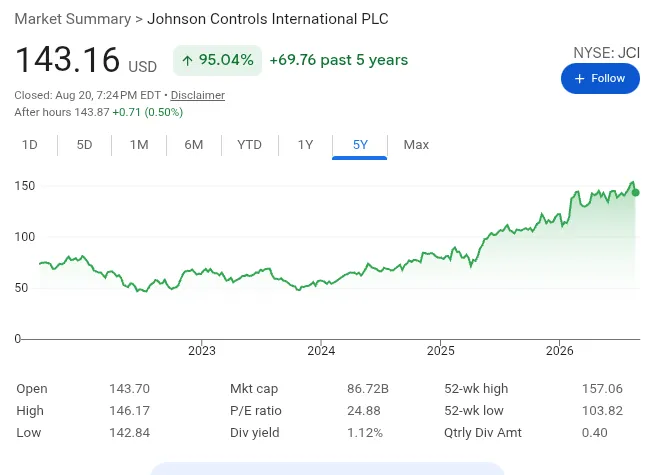
I haven't done a write up in a while simply because the family has kept me busy but as I was changing my car battery I asked myself the question... Who makes these things? A little internet sluething later... Johnson Controls International PLC.
The Price to Earnings Ratio is 41.23 and the Earnings Per Share are 3.55 with a market cap of 88.662B this global company supports car batteries and more across the globe.
With Americans turning to more budget conscious solutions I promise this stock is grow grow grow in the next year.
The video gets really educational around the 11:00 minute mark.
On my bucket list!
Today 1 PESO (MXN) = 0.062648 U.S. DOLLAR (USD) Where the global market is 0.059
I haven't posted in a hot minute but after looking at some iPhones a potential investing solution appeared. Apple computers.... For those who follow major portfolios, Berkshire Hathaway seems to have put a substantial investment in apple and I don't blame them. They're slowly down but over still reaching all time highs. Apple is also one of Yahoo Finances top performing stocks for consumer electronics.
Currently the stock is down 10% from all time highs so it may be a decent buy for those who can afford it.
The video "Gold & Silver Warning: $125 Billion in Treasury Debt Drops This Week" by the channel Precious Metals Intelligence provides a critical analysis of a major financial event: the sale of $125 billion in United States Treasury debt within a single week. While mainstream media often focuses on backward-looking data like inflation reports, the source argues that these debt auctions serve as a forward-looking "test of confidence" that could significantly impact the value of gold, silver, and the US dollar.
The $125 Billion Debt Auction
The central theme of the video is the immediate arrival of three back-to-back Treasury auctions involving short-term notes, medium-term notes, and long-term bonds. This massive influx of $125 billion in new debt is significant because it forces the market to decide if it still trusts the US government enough to lend it money at current interest rates. If demand is weak, interest rates must rise to attract buyers, which then ripples out to affect everything from mortgages and business loans to the stock market and precious metals.
The presenter notes that while the public will be distracted by the Consumer Price Index (CPI) report, that data only reveals what happened last month. In contrast, the Treasury auctions reveal what investors think about the future—specifically, whether they are willing to continue financing American debt at current returns.
The "Japan Connection" and the Global Ripple
A significant portion of the analysis focuses on the economic instability in Japan, which is one of the largest foreign holders of US Treasuries. Japan currently faces an "impossible trilemma": trying to maintain a stable currency, keep bond yields low, and sustain cheap borrowing costs simultaneously. As the Japanese yen weakens and its own bond yields rise toward historic levels (approaching 3% to 3.5%), the Japanese central bank may be forced to sell its US debt holdings to raise cash and support its currency.
This creates a "supply shock" scenario: if Japan dumps US Treasuries at the same time the US government is trying to sell $125 billion in new debt, the surge in supply could push American interest rates sharply higher. This makes the situation in Tokyo a vital "interest rate problem" for American investors, often serving as a signal for movements in gold and silver before they become headline news in Washington.
Technical Signals of Market Health
To determine the success of these auctions, professional investors watch three specific technical signals:
The video outlines two potential outcomes. If inflation is soft but the auctions are weak, investors are signaled as demanding more compensation for risk, which typically causes gold to thrive as a haven. If both inflation is soft and the auctions are strong, both gold and silver are likely to perform well.
Gold vs. Silver: Distinct Market Signals
The source makes an important distinction between the two metals. Gold is a purely monetary metal that thrives on fear and a loss of confidence in government finances. Silver, however, is a "hybrid" asset. While it shares some safe-haven demand with gold, it is also deeply tied to industrial sectors like solar energy and electronics. Consequently, silver requires a reasonably healthy economy to perform strongly; in moments of sudden panic that threaten industrial growth, silver can actually fall even if gold is rising.
The Long-Term Macro Context
Finally, the video places these weekly events against a backdrop of historic fiscal instability. The US national debt is approaching $40 trillion, and the government’s options for managing this debt are increasingly limited by the trade-off between supporting the currency and managing interest costs.
A striking historical point mentioned is that the US dollar has lost more than 85% of its purchasing power since 1971, when the direct link to gold was severed. The video also highlights an "unusual contradiction" regarding America's gold reserves: while the government guards its gold with extreme military security at Fort Knox, it officially values that gold on its books at just $42 per ounce, a price that has not been updated in decades and reflects less than 1% of its current market value.
In conclusion, the video warns that the combination of rising energy prices, growing debt, and the potential for a "job market slowdown" creates a difficult environment for policymakers. Investors are urged to look past the "noise" of monthly inflation reports and focus on the fundamental signals of trust found in the bond auctions and the actions of global central banks
The video "Silver Just Sent a WARNING… And It's About U.S. Debt" by the YouTube channel Precious Metals Intelligence examines a quiet but significant technical signal in the silver market that suggests the global financial system is "running out of room". The presenter argues that silver is currently acting as an early warning system, moving in response to underlying stresses in the U.S. economy before they are officially acknowledged by policymakers.
The Recent Price Breakout
The immediate catalyst for this discussion is silver’s recent sharp climb, moving from approximately $61 to over $66 an ounce in just three trading sessions. While such moves can sometimes be dismissed as routine volatility, analysts suggest this specific rally is different because it follows a weak U.S. jobs report. This labor market data has increased pressure on the Federal Reserve to consider lowering interest rates or easing financial conditions, a policy shift that historically pushes metal prices higher as the currency weakens.
From a technical perspective, silver has broken through its 50-day moving average with significant force. This is a key momentum indicator used by professional traders to signal a shift in market direction. Furthermore, even when silver’s price fell earlier in the year from a high near $120, its long-term upward trend remained intact, suggesting that the broader market direction has not changed despite short-term corrections.
The $40 Trillion Debt Wall
The video identifies the primary driver behind silver’s warning as the unsustainable trajectory of U.S. government debt, which has now surpassed $40 trillion. To illustrate the scale of this figure, the presenter notes that counting to 40 trillion at a rate of one number per second would take over a million years.
However, the more urgent issue is the cost of servicing this debt. As interest rates have risen, the annual interest payments have accelerated to over $1.2 trillion, a figure that now exceeds the entire U.S. national defense budget. Using a household analogy, the presenter compares the government to a family with a large credit card balance; even if they don't spend any new money, a rising interest rate can make their existing monthly payments unmanageable. Unlike a household, however, a government has the unique ability to influence the creation of its own currency to manage its debt, often at the expense of the currency’s long-term value.
The Federal Reserve’s "Impossible Choice"
The core of the "warning" silver is sending involves a fundamental conflict within the Federal Reserve’s mandate. The Fed is responsible for two primary goals: maintaining price stability (controlling inflation) and supporting a functioning financial system. For most of history, these goals coexisted, but the massive debt load has now set them on a collision course:
History suggests that when faced with this choice, policymakers almost always prioritize protecting the financial system and preventing a debt collapse over defeating inflation. This tendency is why investors are currently moving into "hard assets" like silver and gold, which cannot be created out of thin air by a central bank.
Market Anomalies and Professional Positioning
The video highlights an unusual market condition currently taking place: Treasury yields and precious metals are rising simultaneously. Ordinarily, rising yields (higher interest rates) pull money away from metals because silver and gold pay no interest. When they rise together, it suggests that investors are no longer reacting to current inflation data but are instead anticipating an eventual Fed intervention to lower rates or ease policy to save the debt structure.
Data from the "accumulation distribution line" supports this view. This technical measure shows that while silver’s price was falling earlier this year, large, experienced investors were quietly increasing their positions. This "quiet accumulation" by professional capital often precedes a major official acknowledgement of a problem. Additionally, mining company stocks—which act as a leveraged bet on future metal prices—have recently begun breaking out of long sideways trends, further signaling that professional investors are positioning for a significant upward move in metals.
Conclusion
The presenter concludes that the strength in silver, gold, and mining shares is not a series of unrelated events but the early stages of a much larger financial narrative. As energy market instability and slowing labor data add further complexity to the Fed's decision-making, silver is revealing a market that is "reading between the lines". The ultimate warning is that the Federal Reserve may soon be forced into a decision it cannot avoid—one that will likely favor the survival of the debt system over the stability of prices.
The video "China Just Made a Massive Gold Move — Silver Could Be Next" by Money Insights provides a comprehensive analysis of the strategic shifts in China’s precious metals policy in 2026. It details how the People's Bank of China (PBOC) has engaged in an unprecedented gold-buying campaign and how those same economic forces are now spilling over into the silver market.
The 21-Month Gold Buying Streak
In July 2026, China’s central bank quietly added 20 tons of gold to its vaults, marking the largest monthly addition since late 2023. This purchase was part of a larger, disciplined strategy; the PBOC has now reported gold purchases for 21 consecutive months without interruption. Notably, China continued to accumulate gold even as prices reached historically elevated levels, suggesting that Beijing views gold as a long-term reserve asset rather than a short-term trade. By the end of this streak, China's official gold holdings surpassed 2,300 tons.
The Motivation: De-risking and "Financial Sovereignty"
The sources suggest that this aggressive accumulation is a direct response to the 2022 immobilization of $300 billion in Russian foreign exchange reserves by the United States and its allies. This event highlighted the risk of holding national wealth within another country's financial system or under a foreign government’s jurisdiction.
Beijing’s strategy is interpreted as a move toward physical possession and direct control. Unlike US Treasuries, physical gold held within China does not depend on a foreign government's promise to make the asset available. This shift isn't just about price speculation; it is part of a broader reserve strategy to reduce dependence on the US dollar and Western banking systems.
The Silver Connection: A Massive Import Surge
While gold grabbed the headlines, a more dramatic story emerged in the silver market during the first quarter of 2026. China’s silver imports surged to approximately 1,600 tons in Q1 2026, a massive shift for a country that had previously been a significant exporter. In March 2026 alone, imports were reported at 173% above the 10-year seasonal average.
This sudden flip from exporter to importer is driven by the collision of two distinct forces:
The "Hidden Connection" of AI and Energy
The video emphasizes that silver is a critical industrial material due to its exceptional electrical conductivity. The global race to build out AI infrastructure requires immense amounts of electrical equipment and high-performance electronics, all of which rely on silver. Simultaneously, the expansion of solar power and EVs means that several different sectors of the global economy are now competing for the same physical metal. This competition between industrial manufacturers and monetary investors puts significant pressure on available supply.
Supply Deficits and the "Paper vs. Physical" Conflict
The global silver market is projected to face another deficit in 2026, extending a multi-year pattern where demand exceeds mine production and recycling. This imbalance forces the market to draw on existing above-ground inventories.
One of the most concerning signals for the market is the decline in "registered" silver at the Comex in New York—metal specifically available to satisfy delivery obligations for futures contracts. As registered inventories fall while demand for physical delivery increases, the market becomes increasingly sensitive to supply shocks. The video compares this to a bank run scenario, where a sudden surge in depositors demanding physical cash can overwhelm a bank's limited reserves.
The Gold-to-Silver Ratio and Investor Outlook
The source points to the gold-to-silver ratio as a key metric for investors. As of August 2026, the ratio sat at roughly 67:1. Historically, when this ratio becomes elevated and then begins to compress, silver has often outperformed gold as it enters a "catch-up phase".
However, the video also provides a "reality check," warning that silver is one of the most volatile major assets. Forces that drive a powerful rally, such as central bank demand and industrial consumption, can be offset if real interest rates rise, the dollar strengthens, or investment demand cools.
The Global Impact on Households
Ultimately, the video connects these high-level central bank moves to the "kitchen table" of ordinary people. When global institutions shift their savings toward hard assets, it signals a long-term concern about currency values and purchasing power. For a retired pensioner or a young professional, these shifts eventually manifest as changes in inflation, mortgage rates, and the cost of essential goods. The video concludes that understanding these patterns is essential for anyone looking to protect their savings in a changing financial landscape.
The video "Sunday Alert: Gold +$100 & Silver +9% Just Exploded — The Hidden Signal Everyone Missed" by OG John AG Official provides an in-depth analysis of the extraordinary volatility seen in the precious metals markets in 2026. After gold and silver reached historic highs in January, they suffered a massive six-month crash that many analysts are now dismissing as a "dead cat bounce". However, the video argues that the structural bull case remains intact and that a specific mechanical reversal triggered by labor market data has fundamentally shifted the market's direction.
The 2026 Correction: From Peak to Trough
The year began with "extraordinary, almost unbelievable moves" for precious metals. On January 29, 2026, gold hit an all-time high of $5,602 per ounce, while silver reached $121.67 per ounce. These peaks followed a 2025 where gold gained 60% and silver surged 147%. However, by July 2026, gold had fallen 28% to approximately $3,960, and silver had plummeted over 52% to $58 per ounce. This correction was historically sharp; for gold, it was the steepest quarterly drop in 13 years.
Three Forces Behind the Crash
The presenter identifies three specific external forces that drove this painful correction:
The August 7th Reversal
The market sentiment changed abruptly at 8:30 AM on Friday, August 7, 2026, with the release of the US non-farm payrolls (NFP) report. While economists expected the economy to add 80,000 jobs, the report revealed a loss of 23,000 jobs. This shocking data immediately shifted market expectations regarding the Federal Reserve’s next move. The probability of a September rate hike collapsed from a meaningful expectation to just 33%.
The mechanical response was immediate: real yields fell, the US dollar dropped, and precious metals "ripped higher". Gold climbed to $4,350, and silver surged 11% in a single week to $64.10. Notably, the gold-to-silver ratio compressed, a historical signal that the metals are entering an accelerating bull phase rather than a dying one.
Why This Is Not a "Dead Cat Bounce"
OG John AG Official refutes the idea that this is a temporary recovery, citing three structural reasons:
Future Outlook and Signals to Watch
Major financial institutions maintain bullish targets for the end of 2026. Goldman Sachs targets $4,900 for gold, while Bank of America targets $6,000. For silver, Commerce Bank forecasts $90, and Bank of America has modeled a "bull scenario" reaching as high as $135 to $139 if physical shortages intensify.
The video concludes by urging investors to watch three specific signals to determine the strength of this recovery:
Ultimately, the message is that while the July crash was "psychologically brutal," the underlying drivers—central bank buying and industrial silver shortages—remain intact as the market regains its footing in late 2026
